
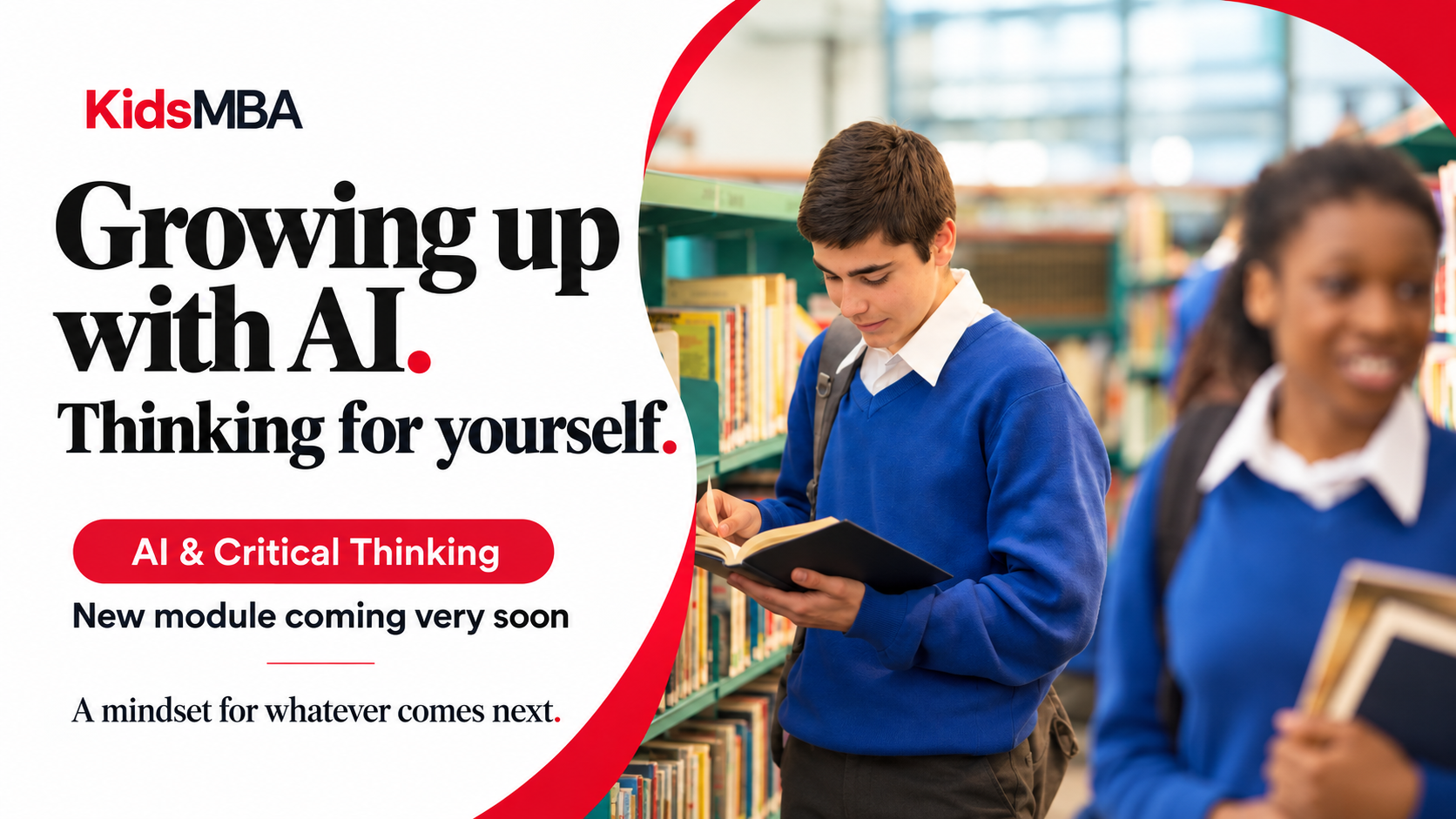
As AI changes education and working life, critical thinking helps young people assess information, make informed decisions and use technology well. At KidsMBA, we see it as a foundation for every career, alongside initiative and an entrepreneurial mindset.
A student submits an impressive assignment. The argument flows, the figures look plausible and the conclusion sounds convincing. Then the teacher asks: “What would make you change your mind?”
That question moves beyond presentation to understanding. It asks the student to examine their evidence, recognise uncertainty and consider another possibility.
As AI makes polished answers easier to produce, education needs to pay closer attention to the thinking behind them. Young people need opportunities to develop the judgement to assess information and the confidence to act on what they learn.
Preparing young people for a changing world of work
The skills required within familiar occupations are changing. Some of the roles today’s children will pursue are still taking shape, while established professions are adopting new tools and responsibilities.
The World Economic Forum’s Future of Jobs Report 2025 draws on more than 1,000 employers representing over 14 million workers. It finds that employers expect 39% of workers’ existing skills to change or become outdated between 2025 and 2030. 86% expect AI and information-processing technologies to transform their businesses over the same period.
These are employer expectations, rather than certain outcomes. They nevertheless give educators a clear reason to prepare young people for continued learning.
A future healthcare professional may assess an AI-supported recommendation. An engineer may investigate an unexpected result from automated software. A teacher may decide whether a digital tool improves a child’s understanding.
Across these situations, subject knowledge and independent judgement will remain essential.
Protecting the work through which learning happens
Schools have long faced pressure to modernise. That makes it important to examine when technology advances learning and when it allows a student to bypass it.
In his World Economic Forum article on teaching in the age of AI, Conrad Hughes, Head of School at the International School of Los Angeles, advocates activities such as careful reading, handwriting, mental arithmetic, debate and oral assessment, alongside purposeful technology use.
His argument provides a useful lens for examining cognitive offloading: handing a mental task to an external tool. The educational consequences depend on which task is handed over and what the student is meant to learn.
If an exercise is designed to develop an understanding of percentages, generating the answer immediately may remove valuable practice. If students already understand percentages and are comparing complex scenarios, a tool may help them explore further.
Writing presents a similar consideration. Organising an explanation can expose a gap in understanding. Receiving a finished paragraph before doing that work may conceal it.
At KidsMBA, we believe the learning objective should guide how technology is used. Students need opportunities to build knowledge, work with assistance and demonstrate what they can do independently.
What critical thinking looks like in practice
Critical thinking becomes meaningful when it informs a decision.
Consider a student examining a forecast that a product will sell 500 units. They might ask where that estimate came from, whether potential customers were consulted and what happens if sales are half the predicted amount.
They are working with evidence, assumptions and consequences. AI could help generate alternative scenarios, while the student assesses whether those scenarios are realistic and useful.
This suggests a practical approach to learning: ask students to make an initial judgement, investigate it, compare alternatives and explain any revision. Teachers can assess the reasoning as well as the result.
It also gives uncertainty a constructive place in the classroom. “I need more information” can be a sound conclusion when a student can explain what is missing and how they would find it.
From critical thinking to an entrepreneurial mindset
Assessing a situation is one part of responding to it. Young people also need the initiative to investigate a problem, involve others and take a considered next step.
These habits sit at the heart of an entrepreneurial mindset: noticing what could improve and taking responsibility for exploring a workable solution.
Their relevance extends across working life. An employee improving a process, a teacher responding to a learning difficulty and a designer addressing an accessibility barrier all need to understand needs, work within constraints and evaluate possible responses.
Entrepreneurship education offers a practical setting for exercising these capabilities. Students encounter connected decisions: a choice about quality affects cost; a price affects demand; feedback may challenge the original plan.
They learn that changing one part of a plan can affect several others. A persuasive answer has to stand up to practical questions.
The World Economic Forum’s employer research reinforces the relevance of these capabilities. Seven in ten surveyed companies consider analytical thinking an essential core skill, while creative thinking, adaptability, curiosity and lifelong learning are expected to grow in importance.
How KidsMBA makes that learning practical
Within the KidsMBA programme, students explore customers, costs, pricing and communication as they develop a proposal and prepare for a Shark Tank-style pitch.
These activities create opportunities to apply knowledge and explain choices. A budget makes trade-offs visible. Discussion introduces competing perspectives. Questions during a pitch reveal how well students understand their proposal.
The educational value develops throughout the process. Students can practise revising an assumption, responding to disagreement and acknowledging the limits of what they know.
For us, an important sign of progress is a student becoming more deliberate: able to describe the options they considered, why they chose an approach and what they would investigate next.
That experience has value whether they eventually start a business, join an organisation or pursue further study. Financial understanding, collaboration and initiative can inform decisions far beyond the classroom.
Coming very soon: AI & Critical Thinking
Our new AI & Critical Thinking module, coming very soon to the KidsMBA programme, will extend this approach.
It will help young people explore what AI is and how it works, alongside the importance of thinking critically about its use. It brings a timely dimension to our wider focus on practical decision-making and an entrepreneurial mindset.
As technology develops, education needs a clear ambition for the learner using it. At KidsMBA, ours is that young people become increasingly capable of investigating a situation, making a considered choice and learning from the outcome.
The student at the beginning of this article may use AI throughout their education and career. What matters is that they can recognise when a conclusion deserves confidence, when it needs checking and when new evidence should change their mind.
Whatever career they choose, that capacity to think, act and keep learning will give them a foundation to build on.
Interested in bringing KidsMBA to your school or organisation? Get in touch with our team to learn more about the programme and our forthcoming AI & Critical Thinking module.
Sources used in this article
World Economic Forum — The Future of Jobs Report 2025
Employer survey findings on changing skills, technological transformation and demand for analytical thinking.
Read the report.
Conrad Hughes — How to teach kids in the age of AI, from the head of a leading LA school
The Head of School at the International School of Los Angeles discusses independent thinking, demanding learning activities and purposeful use of technology.
Read the article.
Further reading
UNESCO — Guidance for Generative AI in Education and Research
Guidance on educational purpose, human judgement, privacy and age-appropriate use of generative AI.
Explore the guidance.
OECD — The Learning Compass 2030
A framework exploring students’ knowledge, skills, attitudes and values, including their ability to set goals, reflect and act responsibly.
Explore the framework.
MIT Media Lab — Your Brain on ChatGPT
Research exploring cognitive engagement during AI-assisted essay writing. Its findings concern a specific writing task and should not be generalised to all learning.
Explore the research.
World Economic Forum — Chief Economists’ Outlook, September 2026
Wider context on AI adoption, productivity, investment and the global business environment.
Read the report.